For most of us, paying for something has become almost invisible.
Tap your phone. Tap your watch. Tap your card. Walk away.
Cash has gradually moved from something we carried every day to something many of us barely think about. That works remarkably well while the systems behind those payments are working too. The problem is that a card payment isn’t really one system at all. It relies on a chain of technology involving your bank, the retailer, payment terminals, communications networks and, in many cases, electricity.
Interrupt one part of that chain and suddenly having plenty of money in your bank account doesn’t necessarily mean you can spend it.
The UK Government’s current Be Ready guidance specifically recommends keeping a mixture of cash, coins and cards at home in case electronic payments or ATMs are disrupted. Its headline household checklist is built around having three days of basic supplies.
Three days is a useful starting point, and certainly better than having no household buffer at all. At Prepared Base, however, we don’t think preparedness should stop there. The Government’s broader emergency guidance itself acknowledges that emergencies can sometimes continue for several days, months or even longer.
That doesn’t mean filling a safe with banknotes or preparing for the collapse of the financial system. It means recognising that payment disruption can accompany power cuts, communications failures, cyber incidents and other emergencies, and building enough redundancy into everyday life that one failed payment method doesn’t immediately become a household problem.
The Bank of England has made essentially the same point from a payments perspective: resilience comes partly from retaining several ways to pay, with cash remaining a practical alternative when other systems are unavailable. It has specifically cited major incidents such as the 2025 outages in Spain and Portugal as examples of why cash continues to have a contingency role.
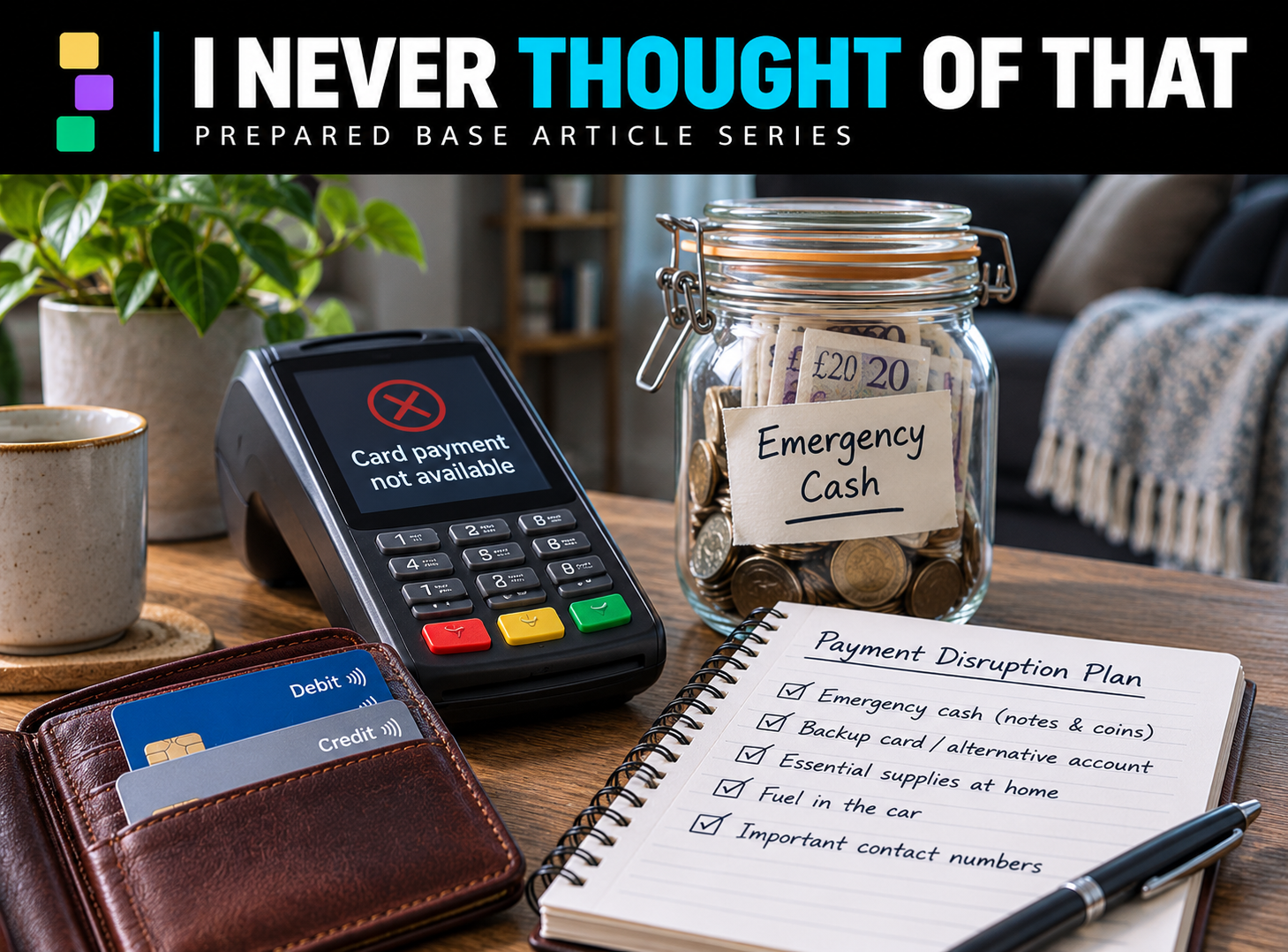
So, beyond simply stuffing a £20 note into a kitchen drawer, what should you actually have?
Here are seven things worth considering.
1. Emergency cash — but in useful denominations
Keeping some emergency cash at home is probably the most obvious entry on this list, but how you keep it matters almost as much as whether you keep it at all.
Imagine card machines have stopped working across your area and the local shop has decided to continue trading using cash. You have £200 tucked away, which sounds reassuring, except it consists entirely of £20 and £50 notes.
The shop has exactly the same problem as everyone else: very little change.
That can turn a surprisingly small purchase into a difficult transaction.
A more useful emergency cash reserve contains a mixture of notes and coins, with plenty of smaller denominations that allow you to pay close to the actual price. Think about the types of purchases your household might genuinely need during several days of disruption — food, fuel, medication, toiletries, pet supplies or local transport — and build your reserve around those needs rather than choosing an arbitrary figure from an emergency checklist.
There is another reason not to keep everything in large notes. During an extended disruption, cash effectively becomes a finite household resource. Paying £7.50 with a £10 note is very different from repeatedly breaking £50 notes and hoping every retailer can provide change.
The objective isn’t to keep a huge quantity of money lying around the house. It’s to make the cash you do keep practical to spend.
2. The physical bank card you stopped carrying
There is an interesting halfway point between everything working normally and the entire electronic payment system failing.
Sometimes the problem isn’t card payments themselves. It is your particular way of accessing them.
Millions of everyday transactions are now made using phones and smartwatches, which means it is increasingly possible to leave home without a wallet at all. That’s wonderfully convenient until your phone is flat, damaged or unable to connect properly, or the digital wallet you’re relying on develops a problem.
A physical debit or credit card gives you another route through the same payment system.
Contactless may fail while chip-and-PIN continues to work. Your phone may be unavailable while the card in your wallet works perfectly normally. A merchant’s terminal may even behave differently depending on how the transaction is being attempted.
None of this means a physical card will rescue you from a widespread electronic payment outage. If the underlying payment infrastructure is unavailable, it won’t.
The point is redundancy.
If you have gradually reached the stage where your phone has become your wallet, putting one physical card back into your emergency kit, wallet or grab bag is a remarkably simple precaution.
3. A second card that isn’t tied to exactly the same place
Two bank cards aren’t necessarily two backup payment methods.
If both cards access the same current account through the same provider, a problem affecting that bank could potentially make both useless at exactly the same time.
For households that already have more than one bank account or card provider, it can therefore make sense to keep access to a secondary account rather than allowing everything to converge onto a single financial service.
This doesn’t require opening a collection of unnecessary accounts purely for emergency purposes. Plenty of households already have a main current account alongside a savings account, credit card or secondary current account.
The preparedness question is simply whether you could actually access that alternative if your primary account became temporarily unavailable.
A second physical card from a genuinely separate account or provider won’t solve a national payment-system failure, but it may solve something much more mundane: your bank’s app being unavailable, your main card being blocked, or an isolated technical problem affecting one provider.
Good resilience rarely means finding one backup that solves everything. More often, it means making sure a single failure doesn’t remove every option you have.
4. A household buffer that means you don’t need to pay at all
This may be the most important item on the list because it changes the problem completely.
The strongest backup to a failed payment system isn’t another payment system.
It’s not needing to make the purchase yet.
If there is food in the cupboard, toilet roll in the bathroom, medication available, dog food in the pantry and enough everyday household essentials to keep going, whether Tesco’s card terminals are working this afternoon suddenly becomes considerably less important.
This is also where we think the three-day preparedness conversation needs to be viewed in context.
Three days of supplies is an excellent first milestone for a household starting from nothing. It shouldn’t necessarily be regarded as the point at which preparation is complete.
You don’t need to buy fourteen days of food in one enormous shop or transform a spare bedroom into a warehouse. In fact, building slowly is usually the more sensible approach. Add an extra tin of something you already eat. Replace toiletries before the previous ones are empty. Keep another bag of pet food in rotation. Gradually deepen the amount of ordinary household stock you carry.
Over time, you create something much more useful than an “emergency food stash”.
You create time.
If an electronic payment outage lasts an afternoon, you barely notice it. If it continues into the following day, you aren’t immediately standing in a queue trying to find somewhere accepting cash. If the payment disruption is part of a larger power cut or infrastructure problem, you have the option of remaining at home while other people are forced out to find supplies.
Preparedness is often described in terms of what you own.
Just as importantly, it is about how long you can comfortably wait.
5. Fuel already in the car
There is an old preparedness habit that deserves far more attention in an increasingly cashless world: don’t routinely run the car close to empty.
Fuel stations are heavily dependent on infrastructure. Pumps require electricity, modern forecourts rely on electronic point-of-sale systems, and most customers now expect to pay using a card or phone.
If a payment outage occurs independently, some petrol stations may still be able to trade through alternative arrangements. If that outage is associated with a wider power or communications failure, the situation becomes considerably less predictable.
Either way, the worst moment to discover you have twenty miles of range remaining is when buying more fuel has suddenly become difficult.
You don’t need to keep petrol cans scattered around the garage. Simply changing your normal behaviour so that half a tank feels more like “time to think about filling up” than “plenty left” creates a useful reserve without storing anything extra at home.
That fuel buys options.
You can collect a family member, reach work, check on someone vulnerable, travel to an area unaffected by a local outage or simply avoid joining the rush to the petrol station as soon as disruption begins.
The principle is exactly the same as keeping food in the cupboard: the resource you already have is one you don’t need to purchase during the emergency.
6. Your important financial information on paper
If card payments aren’t working because of a wider communications or power problem, there’s another difficulty waiting in the background.
A surprising amount of our financial life now exists exclusively inside our phones.
Bank contact numbers. Account details. Insurance information. Policy numbers. Payment references. Details of secondary accounts. Even the number printed on the back of the bank card we need to report missing.
Most of the time that’s enormously convenient. During an outage, however, repeatedly turning on a phone simply to retrieve information consumes battery power, and an internet or mobile-data disruption may make some information inaccessible anyway.
Create a simple household financial emergency sheet.
It doesn’t need to contain passwords, PINs or anything that would create a serious security risk if somebody found it. What it can contain are the practical details you may need to contact institutions and manage your household while online services are unavailable: bank emergency telephone numbers, insurer contact details, relevant account reference numbers, utility contacts and the details of any alternative accounts you deliberately maintain.
Store it somewhere secure alongside the other important documents in your emergency plan.
We have become very good at backing up electricity.
Backing up information deserves the same attention.
7. A way of rationing the cash you have
Cash behaves differently when you’re accustomed to paying electronically.
With card payments, every transaction is automatically recorded. Open your banking app and you can see exactly what you’ve spent.
Cash doesn’t do that for you.
During a prolonged electronic payment outage, that can matter surprisingly quickly. £150 sitting in an envelope feels reassuring on day one. After several people in the household have used some for food, fuel and other purchases, remembering exactly how much remains becomes much harder.
The solution can be remarkably low-tech: a notebook, pencil and a few envelopes.
Divide emergency cash according to purpose or simply write down every amount that leaves the household reserve. If you’re preparing for something potentially longer than a weekend, you can also allocate a rough daily spending allowance while keeping a separate amount untouched for genuine emergencies.
It may sound unnecessarily organised when everything is working normally.
When cash is suddenly the only reliable payment method available, knowing that you have £83 remaining rather than vaguely believing you have “about a hundred quid somewhere” becomes rather more useful.
There is a broader lesson here too. Preparedness isn’t simply about accumulating resources.
It’s about managing them once you need them.
Cash isn’t the answer. Redundancy is.
It would be easy to finish an article about card payment failure by saying everyone should keep cash at home.
You should keep some.
But that misses the more useful lesson.
A resilient household doesn’t depend completely on cash any more than it should depend completely on cards. It has several ways of paying, some physical money available, essential supplies already in the house and enough breathing room that a temporary failure doesn’t immediately demand action.
That distinction becomes even more important when payment disruption isn’t the emergency itself but one consequence of something larger.
A significant power cut can affect communications. Communications failures can affect payment terminals and ATMs. Fuel becomes harder to obtain. Retailers may struggle to operate normally. Other people encounter exactly the same problems at exactly the same time.
The Government’s three-day preparedness recommendation is therefore a very useful place to start. We just wouldn’t treat it as the place to stop.
Preparedness should be built gradually and realistically around your household, your budget and the disruptions you could genuinely face. You don’t need to predict precisely what will happen or spend a fortune preparing for it.
You simply need enough alternatives that when one everyday system disappears, life doesn’t immediately grind to a halt.
And if the card reader flashes red the next time everyone else’s doesn’t work, hopefully you’ll already have thought of that.