Most of us have little reason to think about how much water we use. We turn on the tap, fill the kettle, wash our hands and get on with the day. If the supply stops, those ordinary tasks quickly become part of the same calculation: how much have we got, and how long will it last?
For a three-day emergency, start by setting aside 9 litres of drinking water for each person in your household. That works out at 3 litres per person, per day. You will need additional water for preparing food, basic hygiene, pets and any particular care needs.
The UK Government’s Prepare guidance gives a survival drinking-water allowance of 2.5–3 litres per person daily. It also suggests 10 litres per person, per day to provide for drinking, basic cooking and hygiene. These are planning figures; your household’s circumstances will affect what you need. UK emergency supplies guidance
How much do we need to drink each day?
For everyday hydration, the NHS advises most people to aim for six to eight cups or glasses of fluid daily. Water, tea, coffee and other suitable drinks count, and some fluid comes from food. You may need more during hot weather, prolonged physical activity, pregnancy, breastfeeding or illness. NHS hydration guidance
That everyday guide serves a different purpose from an emergency storage allowance. Your reserve needs to cover changing conditions and the possibility that your usual drinks and meals are unavailable.
Storing 3 litres of drinking water per person daily is a preparedness calculation, rather than an instruction that everyone must drink exactly that amount. If you have a prescribed fluid limit, continue to follow your clinician’s advice.
Work out the amount for your household
Whether you live alone, share a flat or have a large family, the calculation starts with the number of people you expect to be at home.
For drinking water:
Number of people × 3 litres × 3 days
For drinking, basic cooking and hygiene:
Number of people × 10 litres × 3 days
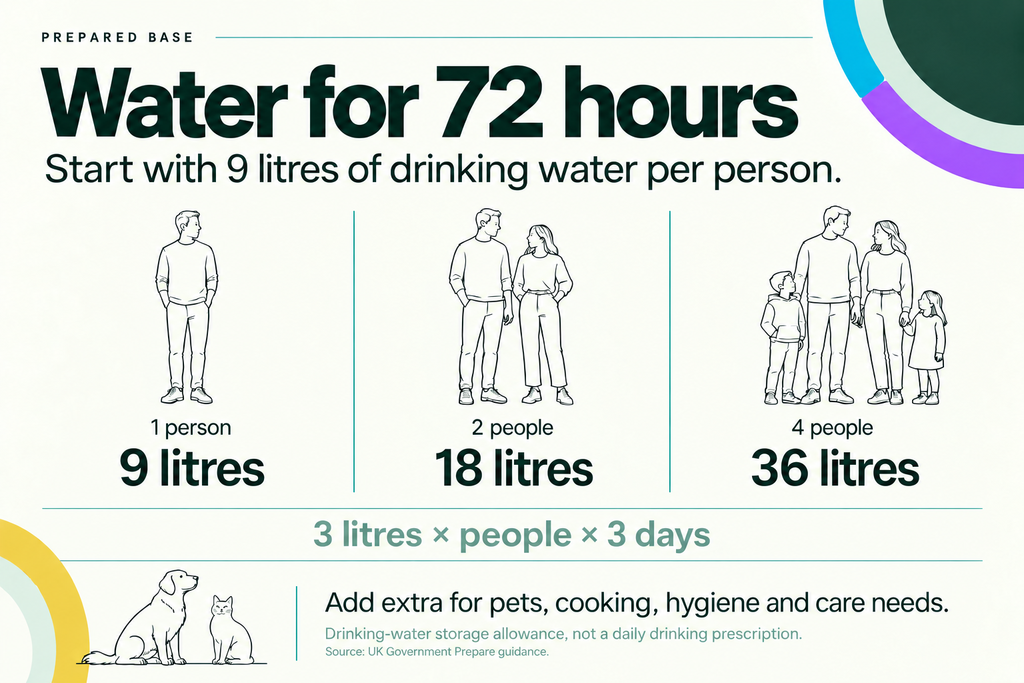
Here is what those calculations look like:
| People in your household | Drinking-water starting amount for 72 hours | Broader provision including basic cooking and hygiene |
|---|---|---|
| 1 | 9 litres | 30 litres |
| 2 | 18 litres | 60 litres |
| 3 | 27 litres | 90 litres |
| 4 | 36 litres | 120 litres |
| 5 | 45 litres | 150 litres |
| 6 | 54 litres | 180 litres |
Calculated from the daily allowances above. Pets and additional care needs are extra.
Count children when planning your reserve. The table is a simple household storage calculation, not an age-specific drinking recommendation. Babies need a separate feeding plan; their allowance should never be interpreted as an amount of plain water to give them.
Think about who might join you, too. If an older relative would stay with you during a prolonged outage, include them in your figures now.
For someone living alone, the drinking-water starting amount is 9 litres: four full 2-litre bottles and another litre. If you have room, rounding that up makes shopping simpler and gives you a little extra.
Include your pets from the start
Your pets will still need fresh drinking water when the taps stop working. Give them their own allowance alongside the household total.
There is no single daily amount that suits every dog or cat. Size, diet, health, activity and temperature all matter. A pet eating dry food may drink more than one eating wet food. PDSA advice on dogs’ water needs
Before an emergency, measure how much your pet normally drinks over several representative days. Use that as a starting point, allow extra for hotter conditions and spills, and ask your vet about any medical needs. Include water for cleaning bowls as well.
For example, if your dog normally drinks 1 litre daily, its usual drinking requirement would add 3 litres to a three-day reserve, before any extra allowance. That is an example calculation, not a recommended amount for every dog.
Check the needs of other animals individually. Rabbits, birds and small pets belong in the plan too.
Remember the water used around a drink
A cupboard full of dried food can create another demand on your supply. Pasta needs cooking water, powdered foods need mixing, and some emergency meals need rehydrating. Look at the food you actually intend to eat and check the preparation instructions.
Keeping some ready-to-eat food gives you more flexibility when both water and power are limited.
Baby feeding deserves particular attention. UK preparedness guidance suggests keeping ready-to-feed formula where needed, because boiling water and sterilising equipment may be difficult during an outage. UK guidance on baby supplies
Medical equipment and care routines may also have specific water requirements. Check these with the relevant provider before an emergency; ordinary bottled drinking water may not meet an equipment manufacturer’s requirements.
Make the reserve manageable
Thirty litres for one person—or 120 litres for four—can look like a lot when you start considering cupboard space. Build towards the amount you need in stages, beginning with drinking water.
Several smaller containers may be easier to store and handle than one large container. Choose sizes that the people in your household can lift and pour from comfortably.
Unopened bottled water is a straightforward option. If you fill containers yourself, use containers intended for storing drinking water, clean and sanitise them properly, and fill them with safe water. Never reuse containers that have held chemicals.
Keep your supply somewhere cool, away from sunlight and substances such as fuel or pesticides. Follow the dates on purchased bottles. For water you store yourself, the CDC recommends replacing it every six months. CDC emergency water storage guidance
Label containers and make sure everyone knows where to find them. If some water is intended only for toilet flushing, keep it clearly separate from drinking water.
A three-day reserve gives you an initial period of cover. As storage space and budget allow, you can extend it using the same calculation.
Start by counting the people and animals you are responsible for. Check what you already have, write down the amount still needed, and choose somewhere suitable to keep it. The next time you do your shopping, you will know exactly what to add.