Most advice about preparing for a power cut begins in roughly the same place: buy a torch, keep some batteries nearby, charge a power bank and make sure there is food and water in the house.
All sensible advice. None of it is particularly surprising.
The more interesting problems tend to appear afterwards, when you realise how many small parts of everyday life quietly depend on electricity. You still have plates to wash, food to protect, people moving around a dark house and a finite amount of battery power that you suddenly become very reluctant to waste.
That is where this series comes in.
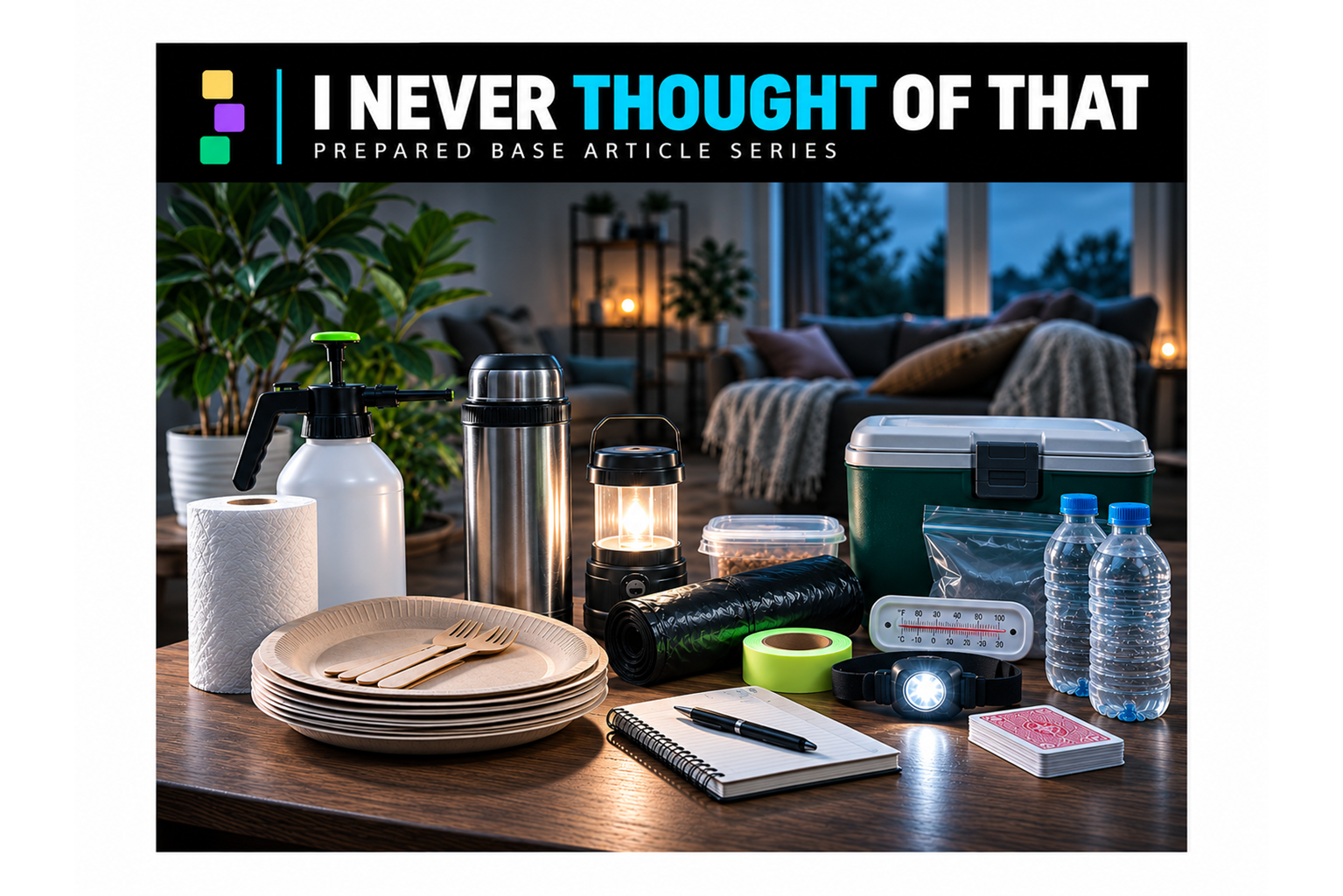
I Never Thought of That is about the inexpensive, easily overlooked things that can make an unexpectedly large difference when normal routines stop working. Not specialist survival equipment and not another shopping list of obvious emergency supplies; just practical ideas that solve problems most of us don’t notice until we are already dealing with them.
For a power cut, these are 15 of our favourites.
1. Paper plates and bowls
It sounds almost too mundane to deserve first place, but paper plates are a perfect example of the thinking behind this series.
If a power cut is short, washing up is hardly an issue. If it forms part of a wider disruption, however, particularly one affecting water supply or hot water, every sink full of dishes starts consuming a resource you may want for something more important.
Keeping a pack of simple disposable plates and bowls allows you to remove most of that washing-up altogether. They cost very little, store flat and can sit forgotten at the back of a cupboard until they are needed.
Choose plain paper or compostable versions where possible and dispose of them appropriately afterwards rather than assuming anything labelled “paper” is suitable for burning; some products contain coatings, inks or other materials you do not want on a fire.
It’s a tiny change, but that is rather the point. You are not storing plates. You are storing the water you won’t have to use washing them.
2. Baking parchment and heavy-duty foil
The same principle can be taken a step further.
When cooking without your normal kitchen setup, particularly on a camping stove or other backup cooking equipment, the last thing you want is a collection of greasy pans that need scrubbing afterwards.
Lining suitable cookware with baking parchment or foil can dramatically reduce the mess left behind. Foil can also cover opened food, create temporary lids and help separate ingredients, while parchment is particularly useful for keeping cooking surfaces cleaner.
Neither is an emergency product, which is exactly why both are easy to overlook.
A surprising amount of sensible preparedness is simply about reducing the amount of cleaning you will have to do later.
3. A brand-new pump pressure sprayer
This may be the strangest-looking item in your emergency cupboard.
Small pump-action pressure sprayers are usually sold for gardening, but a new sprayer that has never contained chemicals and is clearly marked for clean-water use only can become an excellent way of controlling how much water you use.
Instead of tipping half a bottle over your hands while trying to wash them, you can produce a gentle, directed spray. The same principle works for rinsing utensils, cleaning a small surface or carrying out basic personal washing.
It doesn’t create water, obviously. It simply makes the water you already have much easier to ration.
And when stored water becomes valuable, controlling the flow can matter almost as much as controlling the quantity.
4. A washing-up bowl
Many modern kitchens don’t actually use one anymore. We wash things beneath running taps, rinse as we go and rarely think about how much water disappears down the drain.
During a disruption, that habit becomes surprisingly wasteful.
A basic washing-up bowl lets you allocate a fixed amount of water to the job rather than continuously drawing more. It can also be lifted out of the sink so that relatively clean grey water can be retained for another appropriate household use rather than automatically disappearing down the plughole.
There is nothing glamorous about a plastic bowl.
There is, however, something rather useful about knowing exactly how much water you’re using.
5. No-rinse body wash
Losing electricity does not necessarily mean losing water, but it may mean losing hot water. In a wider infrastructure problem, you could eventually find yourself trying to conserve both.
That is when products developed for situations where conventional bathing is difficult start to make a lot more sense.
No-rinse body washes allow you to clean yourself with a cloth and towel off afterwards, while shampoo caps can provide a similar solution for hair without standing underneath a shower.
They are widely used in healthcare and camping, yet rarely appear on household preparedness lists.
Being able to stay reasonably clean without turning several litres of precious warm water into bathwater is exactly the sort of small advantage that becomes increasingly valuable the longer a disruption lasts.
6. A sturdy bucket with a proper lid
Few products offer as much utility for as little money as a decent bucket.
It can carry water, hold washing water, store dirty clothes, contain rubbish, move supplies around the house or become part of an emergency sanitation setup if normal facilities stop working.
The lid is what turns it from merely useful into something worth deliberately storing. It allows smells, waste, damp items or contaminated materials to be contained rather than simply sitting open inside the house.
You do not need specialist survival branding or an elaborate folding version. A strong, food-safe or heavy-duty bucket with a secure lid is enough.
It is one of those things you may find yourself using repeatedly while wondering why it never made the conventional emergency checklist.
7. Proper heavy-duty bin bags
Ordinary kitchen bin bags are designed to carry kitchen rubbish from the bin to the wheelie bin. Ask them to do much more and many will split almost immediately.
Heavy-duty refuse or rubble sacks are different.
During a prolonged disruption they can contain wet clothes, food waste, dirty materials or emergency toilet waste; protect possessions from leaks; separate clean equipment from dirty equipment; or act as temporary waterproof storage.
A roll takes up almost no room, doesn’t expire and costs comparatively little.
The clever part isn’t any single use. It’s the fact that when something wet, dirty, unpleasant or leaking suddenly needs to be contained, a strong waterproof bag gives you an immediate answer.
8. A fridge and freezer thermometer
When the power disappears, your fridge and freezer effectively become very well-insulated boxes with a limited amount of cold trapped inside them.
From that moment onwards, your job is to preserve as much of that cold as possible.
A simple fridge/freezer thermometer removes a lot of the guesswork. Rather than repeatedly opening the door, touching packages and wondering whether everything still feels cold enough, you have a much clearer picture of what is happening inside.
That matters because a fridge full of food can represent hundreds of pounds, and unnecessary door-opening only accelerates the warming process.
Which leads us to something considerably more peculiar.
9. A child lock for the fridge
Even if there are no children in the house.
During an outage, everyone knows they shouldn’t keep opening the fridge. Everyone will probably open it anyway.
Someone wants milk. Someone else wants a snack. Then somebody decides to check whether the freezer is still frozen.
Fitting a cheap external child lock creates a tiny moment of friction before the door opens. It isn’t really a security device in this situation; it’s a behavioural reminder.
Do I actually need to open this?
That extra second of thought can stop the fridge becoming something people casually browse through every twenty minutes.
It may be one of the stranger ways to protect your food during a blackout, but it makes perfect sense once you think about it.
10. Bottles of frozen water
Empty space inside your freezer isn’t particularly helpful when the electricity fails.
Frozen water is.
If you have spare freezer capacity, keeping a few suitable containers partially filled with water and permanently frozen gives you additional thermal mass. Leave enough space for the water to expand as it freezes and you effectively have large reusable ice blocks sitting ready for an outage.
They can remain in the freezer to help maintain the cold environment or be moved into an insulated cool box if you need to protect particular foods separately.
You haven’t bought an emergency gadget.
You’ve simply stored some cold in advance.
11. A large vacuum flask
Most of us think about storing electricity during a power cut. It is worth thinking about stored heat as well.
If you are using a camping stove or another safe backup method to boil water, repeatedly heating small amounts throughout the day uses more fuel and requires you to keep setting the equipment up.
A good vacuum flask lets you boil more water while the stove is running and retain some of that heat for later.
Tea and coffee are the obvious uses, but hot water can also be useful for instant foods, cleaning or simply providing a warm drink later in the evening.
The flask effectively becomes a battery for heat: charge it once, use the energy later.
12. Glow-in-the-dark tape
There is a particular absurdity to knowing exactly where your torch is kept but being unable to find it because you need the torch to see where it is kept.
A few deliberately positioned pieces of photoluminescent tape can solve that.
Mark your main torch, first-aid kit, fuse box and other important equipment. Small strips can also identify awkward steps, door handles or the route to a bathroom without requiring you to illuminate the entire house.
You don’t need to transform your hallway into an aircraft runway. Used sparingly, it simply provides a handful of visual reference points once your eyes have adjusted to the darkness.
Sometimes preparedness is no more complicated than making the thing you need easier to find.
13. Battery-powered PIR lights
Emergency lighting doesn’t have to mean lighting entire rooms for hours at a time.
Small motion-sensor lights are particularly useful in spaces where you only need illumination for a few seconds: hallways, stairs, landings, bathrooms or the route into the kitchen.
Instead of carrying a torch everywhere or leaving a lantern running simply so nobody trips over on the way to the loo, the light comes on when someone approaches and switches itself off afterwards.
Many households already use them inside cupboards or wardrobes.
Moving that same idea onto a staircase during a power cut suddenly makes them feel considerably more useful.
14. Solar garden lights
If you already have solar lights sitting outside, you may already own backup lighting without realising it.
Many standalone garden lights spend the day charging a small internal battery from their solar panel and then illuminate automatically when it gets dark.
Provided yours can be moved safely, bringing a few indoors in the evening can provide gentle background lighting without using your torches, disposable batteries or power banks. Put them back outside the following day and let the sun recharge them.
They won’t replace a proper lantern when you need bright task lighting, but that isn’t really their job.
Their job is to stop you wasting your better power sources simply to put a little light into a dark hallway.
15. A printed household information sheet
We have quietly moved an extraordinary amount of useful information into devices that require electricity.
Phone numbers. Insurance details. Medication information. Utility contacts. School numbers. Addresses. Policy references. Emergency contacts.
Then, when battery life suddenly matters, we repeatedly switch the phone on to retrieve them.
One sheet of paper can remove that dependency.
Keep essential household contacts and information together and store a copy with your emergency supplies. You don’t need to print every detail of your life; just ask yourself what information you would struggle to retrieve if your phone were unavailable.
It costs virtually nothing, consumes no power and works even when every screen in the house is black.
Which is rather difficult to improve upon.
The useful question isn’t “What should I buy?”
There is a common trap with preparedness: we start by thinking about products.
A better place to start is with inconvenience.
If the electricity disappeared tonight, what would become unexpectedly difficult? What would start wasting resources? Which everyday habit suddenly wouldn’t make sense anymore?
That change in perspective is why paper plates can belong on the same preparedness list as freezer thermometers and solar lights. None is particularly dramatic in isolation. Each simply solves a problem before that problem becomes irritating, expensive or potentially more serious.
And that’s the thinking behind I Never Thought of That.
We’re not interested in repeating the things everyone already knows they should have.
We’re interested in the things that make you stop for a second and think:
Actually… that’s a really good idea.